Welcome back, my friends! Book Club convenes once more. First on the agenda, Ender's Game by Orson Scott Card. Here is my take:
At age 6, Andrew "Ender" Wiggin leaves his home and family for Battle School. A space station where he will be trained in military strategy.
It's really hard to remember that Ender starts the book at age six—every time the author mentions it, it seems like a surprise.
Six years old, and he can set up security systems, master battle techniques, and outthink his commanding officer. Which he does throughout the entire book, I might add, despite his age at any given point.
Ender advances through the ranks with remarkable speed. He is promoted from his launch group (the other kids his age with whom he traveled to the space station) and assigned to an army when he is still 6. Most kids don't advance until age 8.
The purpose of the different armies is to fight mock battles and, in so doing, learn battle technique and strategy. The armies are all named after animals/bugs, e.g. Condor Army, Salamander Army, Rat Army, Scorpion Army, Centipede Army, and so on.
The first army to which Ender is assigned is Salamander Army. His commanding officer, Bonzo, didn't appreciate having the disadvantage of an unexperienced soldier. Bonzo's disdain for Ender continues throughout the book.
Shortly after Ender had been transferred to Salamander Army: “He could see Bonzo’s anger growing
hot. Hot anger was bad. Ender’s anger
was cold, and he could use it. Bonzo’s
was hot, and so it used him.” Ender's calm thinking and strategy make him the best soldier the Battle School has ever seen.
Later on in the book, when Bonzo and company ganged up on Ender in the shower: “He refused to feel
weak because he was wet and cold and
unclothed. He stood strongly, facing them,
his arms at his sides.” I admire Ender's courage. He refused to feel weak just because he was at a disadvantage.
Ender can be calculating, but he has a conscience. He doesn’t just hurt people because he likes the rush of power. He does what is necessary to keep himself safe. And he always feels bad afterwards because he doesn’t want to hurt others. As evidenced by his thoughts:
“Everything they can do to beat me,
thought Ender. Everything they can think
of, change all the rules, they don’t care,
just so they beat me. Well, I’m sick of the
game. No game is worth Bonzo’s blood
pinking the water on the bathroom floor.
Ice me, send me home, I don’t want to
play anymore.”
When Ender was given an army himself to command, his soldiers advanced quicker than any others. One such solder, Bean (also very young) became a commander as soon as Ender graduated from Battle School (at the ripe old age of 10). “[Bean] was a
soldier, and if anyone had asked him what
he wanted to be when he grew up, he
wouldn’t have known what they meant.”
This is one element of the story that I find very sad: the Battle School robbed Ender (and those like him) of his childhood.
I don't want to introduce any spoilers, so I will just say this: I think it’s pretty sleazy the way the military deceived Ender. I understand the rationale, but it’s sleazy just the same.
The ending was just okay to me. I think it was supposed to be peaceful and profound and whatnot. Meh. Didn’t really resonate with me. I thought it was a bit weak.
I’m glad Ender found a way to be happy-ish, I suppose. But mostly I thought he deserved more than that after all he went through.
Even so, I enjoyed it overall. Ender's Game is an interesting story that kept my attention.
Ready for next month? My pick for October is
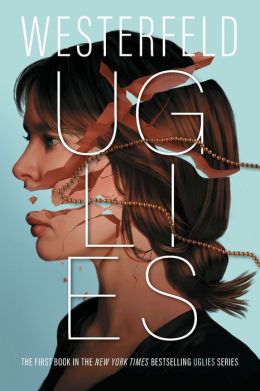
Uglies
by Scott Westerfeld
Uglies was recommended to me by a friend studying children's literature. In just one semester, she had to read 25 books for her major. Uglies was one of the 25, and she said it was worth the read.
Uglies is both sci-fi and dystopian. I liked the last sci-fi book I read (see above), so I'll give the genre another chance. Dystopian novels (think Hunger Games or Divergent) seem to be in vogue now, too, so the time is ripe for reading this book.
According to Wikipedia, a movie adaptation is in the works. I always enjoy reading the books behind books-turned-movies. Uglies is the first in a series, so if I like this one, I'll stay busy reading the rest. Reading one book that leads me to others is always a plus.
From Goodreads: Tally Youngblood is about to turn sixteen, and she can't wait for the operation that turns everyone from a repellent ugly into a stunningly attractive pretty and catapults you into a high-tech paradise where your only job is to party. But new friend Shay would rather hoverboard to "the Smoke" and be free. Tally learns about a whole new side of the pretty world and it isn't very pretty. The "Special Circumstances" authority Dr Cable offers Tally the worst choice she can imagine: find her friend and turn her in, or never turn pretty at all. The choice Tally makes changes her world forever.
Uglies earns an average rating of 3.88 stars on Goodreads, 4.3 stars on Amazon, and 4.5 stars on Barnes & Noble. Not bad.
See me next month for my review!
Pages
“This world is but a canvas to our imaginations.” — Henry David Thoreau
Friday, September 27, 2013
Tuesday, September 17, 2013
YW Value Signs & Class Signs
For those of you who don't know, I am a member of The Church of Jesus Christ of Latter-day Saints (sometimes known as the Mormon Church).
In our church, we have a program for Young Women that starts when girls turn 12. Part of this program is an event called New Beginnings that usually takes place at either the beginning of the calendar year or the beginning of the school year. This event is intended to welcome new young women and introduce them to the Young Women's (YW) program.
This year, we had our New Beginnings in September. We decorated our Young Women's room with a colorful banner, and signs about Young Women. I had fun designing signs that represent the Young Women Values (Faith, Divine Nature, Individual Worth, Knowledge, Choice & Accountability, Good Works, Integrity, Virtue) and the YW classes (Beehives, Mia Maids, Laurels).
I would love to share my designs with you! Each sign is designed to fit a standard 8 1/2 x 11 inch piece of paper or cardstock.
For the YW Values, I printed each one, then cut a 1-inch border on each of the sides (leaving me with a 6 1/2 x 9 inch paper). I then mounted each of these on an 8 1/2 x 11 inch piece of colored cardstock. For the value of virtue, I found some really awesome sparkly gold poster board. We covered our bulletin board with it, and we happened to have a piece left over that measured 8 1/2 x 22 inches. I cut it in half, and voila! gold border for my Virtue sign. How serendipitous.
The background pattern extends to the edges of the page, if you would rather not cut and mount them. You could also cut or print these to be 8x10 and display them in picture frames.
Find the YW Value signs here (this is a link to a google doc, which you should be able to download).
I printed the YW class signs on white cardstock. There is no special background for them, and the text extends closer to the edge of the page than the YW Value signs. These also could be printed and displayed in 8x10 inch frames if you so choose.
For the YW Class signs, click here (also a google doc).
Even if you aren't having New Beginnings at this time, I hope these will be helpful to you for YW room decor. Our girls loved the new decorations and asked that we leave them up.
In our church, we have a program for Young Women that starts when girls turn 12. Part of this program is an event called New Beginnings that usually takes place at either the beginning of the calendar year or the beginning of the school year. This event is intended to welcome new young women and introduce them to the Young Women's (YW) program.
This year, we had our New Beginnings in September. We decorated our Young Women's room with a colorful banner, and signs about Young Women. I had fun designing signs that represent the Young Women Values (Faith, Divine Nature, Individual Worth, Knowledge, Choice & Accountability, Good Works, Integrity, Virtue) and the YW classes (Beehives, Mia Maids, Laurels).
I would love to share my designs with you! Each sign is designed to fit a standard 8 1/2 x 11 inch piece of paper or cardstock.
For the YW Values, I printed each one, then cut a 1-inch border on each of the sides (leaving me with a 6 1/2 x 9 inch paper). I then mounted each of these on an 8 1/2 x 11 inch piece of colored cardstock. For the value of virtue, I found some really awesome sparkly gold poster board. We covered our bulletin board with it, and we happened to have a piece left over that measured 8 1/2 x 22 inches. I cut it in half, and voila! gold border for my Virtue sign. How serendipitous.
The background pattern extends to the edges of the page, if you would rather not cut and mount them. You could also cut or print these to be 8x10 and display them in picture frames.
I printed the YW class signs on white cardstock. There is no special background for them, and the text extends closer to the edge of the page than the YW Value signs. These also could be printed and displayed in 8x10 inch frames if you so choose.
For the YW Class signs, click here (also a google doc).
Even if you aren't having New Beginnings at this time, I hope these will be helpful to you for YW room decor. Our girls loved the new decorations and asked that we leave them up.
Thursday, September 12, 2013
Wednesday, September 4, 2013
Would you fall to pieces if I never came back?
I'm lovin' on Matt Nathanson right now.
This song isn't recent, but it's one of my faves.
Here's a peppy one that really makes me happy:
What are you lovin' on today?
This song isn't recent, but it's one of my faves.
Here's a peppy one that really makes me happy:
What are you lovin' on today?
Tuesday, August 27, 2013
The Anatomy of Peace Review & Book-of-September
Welcome, once again, to Book Club! First order of business: The Anatomy of Peace by the Arbinger Institute.
The main premise of the book is that solutions to people problems are always deeper than outward actions. The Arbinger Institute uses a story format to teach these principles. The story focuses on a man named Lou and his relationships with family members and coworkers. The writing style is cheesy at times, but the concepts within more than make up for it in my opinion.
The terms “heart at peace” and “heart at war” seemed hokey to me at first, but these are simply terms for a concept I don’t find hokey at all:
“In every moment, we are choosing…In the way we regard our children, our spouses, neighbors, colleagues, and strangers, we choose to see others either as people like ourselves or objects. They either count like we do or they don’t. In the former case, since we regard them as we regard ourselves, we say our hearts are at peace toward them. In the latter case, since we systematically view them as inferior, we say our hearts are at war.”
The part of the book that hit me the hardest is toward the beginning: “Seeing an equal person as an inferior object is an act of violence, Lou. It hurts as much as a punch to the face. In fact, in many ways it hurts more. Bruises heal more quickly than emotional scars do.”
This really made me sit up and pay attention.
I read this book for the first time when I was in college. It was an extra credit assignment for one of my classes. It really opened my eyes. The ideas contained in this book were very new to me. Now, it’s almost old hat. But not because the lessons aren’t profound for me any longer, but just because they are so familiar I take them for granted. When I first read this book, I tried really hard to constantly keep my heart at peace. I thought it got good at it, too.
I lived for a long time thinking I had this mastered—keeping my heart at peace. It occurred to me recently that I am good at surrounding myself with people with whom I am at peace. When I come in contact with someone at war, I still am quick to take up my own weapons and go to war myself.
Of course, as The Anatomy of Peace points out: “…difficult choices are still choices. No one, whatever their actions, can deprive me of the ability to choose my own way of being. Difficult people are nevertheless people, and it always remains in my power to see them that way.”
Such a profound read. I hope you add it to your to-read list if you haven't already.
Now for next month. For September, my pick is
Ender's Game
by Orson Scott Card
This is a title I've heard about for years. It's been on my to-read list for quite some time, but sci-fi isn't usually my genre. Since the movie will be hitting the box office in November, I think it's time to give Ender's Game a try. I figure if I read it this month, I can beat the library rush. (If you're a true bookworm, you know what I'm talking about.)
From Goodreads: In order to develop a secure defense against a hostile alien race's next attack, government agencies breed child geniuses and train them as soldiers. A brilliant young boy, Andrew "Ender" Wiggin lives with his kind but distant parents, his sadistic brother Peter, and the person he loves more than anyone else, his sister Valentine. Peter and Valentine were candidates for the soldier-training program but didn't make the cut—young Ender is the Wiggin drafted to the orbiting Battle School for rigorous military training.
Ender's skills make him a leader in school and respected in the Battle Room, where children play at mock battles in zero gravity. Yet growing up in an artificial community of young soldiers Ender suffers greatly from isolation, rivalry from his peers, pressure from the adult teachers, and an unsettling fear of the alien invaders. His psychological battles include loneliness, fear that he is becoming like the cruel brother he remembers, and fanning the flames of devotion to his beloved sister.
Is Ender the general Earth needs? But Ender is not the only result of the genetic experiments. The war with the Buggers has been raging for a hundred years, and the quest for the perfect general has been underway for almost as long. Ender's two older siblings are every bit as unusual as he is, but in very different ways. Between the three of them lie the abilities to remake a world. If, that is, the world survives.
Ender's Game has an average rating of 4.28 stars on Goodreads and 4.6 stars on Amazon. In addition, Ender's Game is the winner of the 1985 Nebula Award for Best Novel and the 1986 Hugo Award for Best Novel. Impressive résumé!
Hit me back next month for my review!
The main premise of the book is that solutions to people problems are always deeper than outward actions. The Arbinger Institute uses a story format to teach these principles. The story focuses on a man named Lou and his relationships with family members and coworkers. The writing style is cheesy at times, but the concepts within more than make up for it in my opinion.
The terms “heart at peace” and “heart at war” seemed hokey to me at first, but these are simply terms for a concept I don’t find hokey at all:
“In every moment, we are choosing…In the way we regard our children, our spouses, neighbors, colleagues, and strangers, we choose to see others either as people like ourselves or objects. They either count like we do or they don’t. In the former case, since we regard them as we regard ourselves, we say our hearts are at peace toward them. In the latter case, since we systematically view them as inferior, we say our hearts are at war.”
The part of the book that hit me the hardest is toward the beginning: “Seeing an equal person as an inferior object is an act of violence, Lou. It hurts as much as a punch to the face. In fact, in many ways it hurts more. Bruises heal more quickly than emotional scars do.”
This really made me sit up and pay attention.
I read this book for the first time when I was in college. It was an extra credit assignment for one of my classes. It really opened my eyes. The ideas contained in this book were very new to me. Now, it’s almost old hat. But not because the lessons aren’t profound for me any longer, but just because they are so familiar I take them for granted. When I first read this book, I tried really hard to constantly keep my heart at peace. I thought it got good at it, too.
I lived for a long time thinking I had this mastered—keeping my heart at peace. It occurred to me recently that I am good at surrounding myself with people with whom I am at peace. When I come in contact with someone at war, I still am quick to take up my own weapons and go to war myself.
Of course, as The Anatomy of Peace points out: “…difficult choices are still choices. No one, whatever their actions, can deprive me of the ability to choose my own way of being. Difficult people are nevertheless people, and it always remains in my power to see them that way.”
Such a profound read. I hope you add it to your to-read list if you haven't already.
Now for next month. For September, my pick is
![]() |
| (source) |
by Orson Scott Card
This is a title I've heard about for years. It's been on my to-read list for quite some time, but sci-fi isn't usually my genre. Since the movie will be hitting the box office in November, I think it's time to give Ender's Game a try. I figure if I read it this month, I can beat the library rush. (If you're a true bookworm, you know what I'm talking about.)
From Goodreads: In order to develop a secure defense against a hostile alien race's next attack, government agencies breed child geniuses and train them as soldiers. A brilliant young boy, Andrew "Ender" Wiggin lives with his kind but distant parents, his sadistic brother Peter, and the person he loves more than anyone else, his sister Valentine. Peter and Valentine were candidates for the soldier-training program but didn't make the cut—young Ender is the Wiggin drafted to the orbiting Battle School for rigorous military training.
Ender's skills make him a leader in school and respected in the Battle Room, where children play at mock battles in zero gravity. Yet growing up in an artificial community of young soldiers Ender suffers greatly from isolation, rivalry from his peers, pressure from the adult teachers, and an unsettling fear of the alien invaders. His psychological battles include loneliness, fear that he is becoming like the cruel brother he remembers, and fanning the flames of devotion to his beloved sister.
Is Ender the general Earth needs? But Ender is not the only result of the genetic experiments. The war with the Buggers has been raging for a hundred years, and the quest for the perfect general has been underway for almost as long. Ender's two older siblings are every bit as unusual as he is, but in very different ways. Between the three of them lie the abilities to remake a world. If, that is, the world survives.
Ender's Game has an average rating of 4.28 stars on Goodreads and 4.6 stars on Amazon. In addition, Ender's Game is the winner of the 1985 Nebula Award for Best Novel and the 1986 Hugo Award for Best Novel. Impressive résumé!
Hit me back next month for my review!
Monday, August 19, 2013
Tuesday, August 6, 2013
Summer Chicken Salad
I know you can eat chicken salad any time of the year, but it just seems summer-y to me. Maybe it's because this is the go-to choice for family picnics: everyone loves it, and it's fairly easy to transport. We just take one big container of chicken salad and a loaf of bread. Easy peasy. (Of course, we always pack it in ice so the mayo doesn't go bad. Since we like cold drinks anyway, we just throw it in the cooler with our beverages.)
I like most versions of chicken salad, but this one is extra special to me. The ranch seasoning adds a burst of flavor, and the cashews bring a richness that makes this salad feel decadent. In contrast to the popular grape-studded chicken salads out there, I love the crunchy apples and celery thrown into the mix here. Give it a try!
Summer Chicken Salad
Recipe by Sara (stuff-by-sara.blogspot.com)
½ cup mayonnaise
½ cup sour cream or Greek yogurt
1 packet ranch dressing mix
¼ tsp freshly ground black pepper
4-5 cooked chicken breasts, diced or shredded
1 cup cashews
1 cup celery, diced
1 chopped apple
Stir together mayonnaise, sour cream or yogurt, dressing mix, and pepper. Gently toss with chicken, cashews, celery, and apple. Serve on sliced bread, rolls, or croissants. For a carb-friendly option, try wrapping the salad in a lettuce leaf.
Savor some today!
I like most versions of chicken salad, but this one is extra special to me. The ranch seasoning adds a burst of flavor, and the cashews bring a richness that makes this salad feel decadent. In contrast to the popular grape-studded chicken salads out there, I love the crunchy apples and celery thrown into the mix here. Give it a try!
Summer Chicken Salad
Recipe by Sara (stuff-by-sara.blogspot.com)
½ cup mayonnaise
½ cup sour cream or Greek yogurt
1 packet ranch dressing mix
¼ tsp freshly ground black pepper
4-5 cooked chicken breasts, diced or shredded
1 cup cashews
1 cup celery, diced
1 chopped apple
Stir together mayonnaise, sour cream or yogurt, dressing mix, and pepper. Gently toss with chicken, cashews, celery, and apple. Serve on sliced bread, rolls, or croissants. For a carb-friendly option, try wrapping the salad in a lettuce leaf.
Savor some today!
Subscribe to:
Posts (Atom)


